Every gazelle is an antelope, but not every antelope is a gazelle, and East Africa is one of the best places in the world to tell them apart.
On safari you will hear your guide say “antelope” and “gazelle” as if they were separate groups. The difference is simple once you know the logic. “Antelope” is an everyday word for dozens of hoofed, horned mammals in the bovid family that are not cattle, sheep or goats. A gazelle is one particular kind of antelope: usually small, slender, fast and tan with a pale belly. This guide sorts out the terms and introduces the species you are likely to see.
Quick FactsA loose group of around ninety species of African and Asian bovids, from the tiny dik-dik to the huge eland.
A group of slender, graceful antelope in the genus Gazella and related genera.
Antelope horns are permanent and unbranched, unlike deer antlers, which are shed yearly.
Maasai Mara, Serengeti, Amboseli, Nairobi National Park, Lake Mburo and Akagera.
There is no single scientific group called antelope, which is why the word is slippery. It is used for many species of bovid, including impala, kudu, eland, oryx, topi, hartebeest, waterbuck, reedbuck, bushbuck, duikers and dik-diks. Even wildebeest are classed as antelope. All have unbranched, permanent horns, a feature that separates them from deer.
Gazelles are the lightweight sprinters of the antelope world. They are small to medium, built for speed, usually sandy brown with a white belly and often a dark stripe along the flank. In East Africa, you are most likely to meet Thomson’s gazelle, which has a bold black side stripe and constantly flicks its tail, and the larger Grant’s gazelle, which has longer, lyre-shaped horns and a white rump patch.
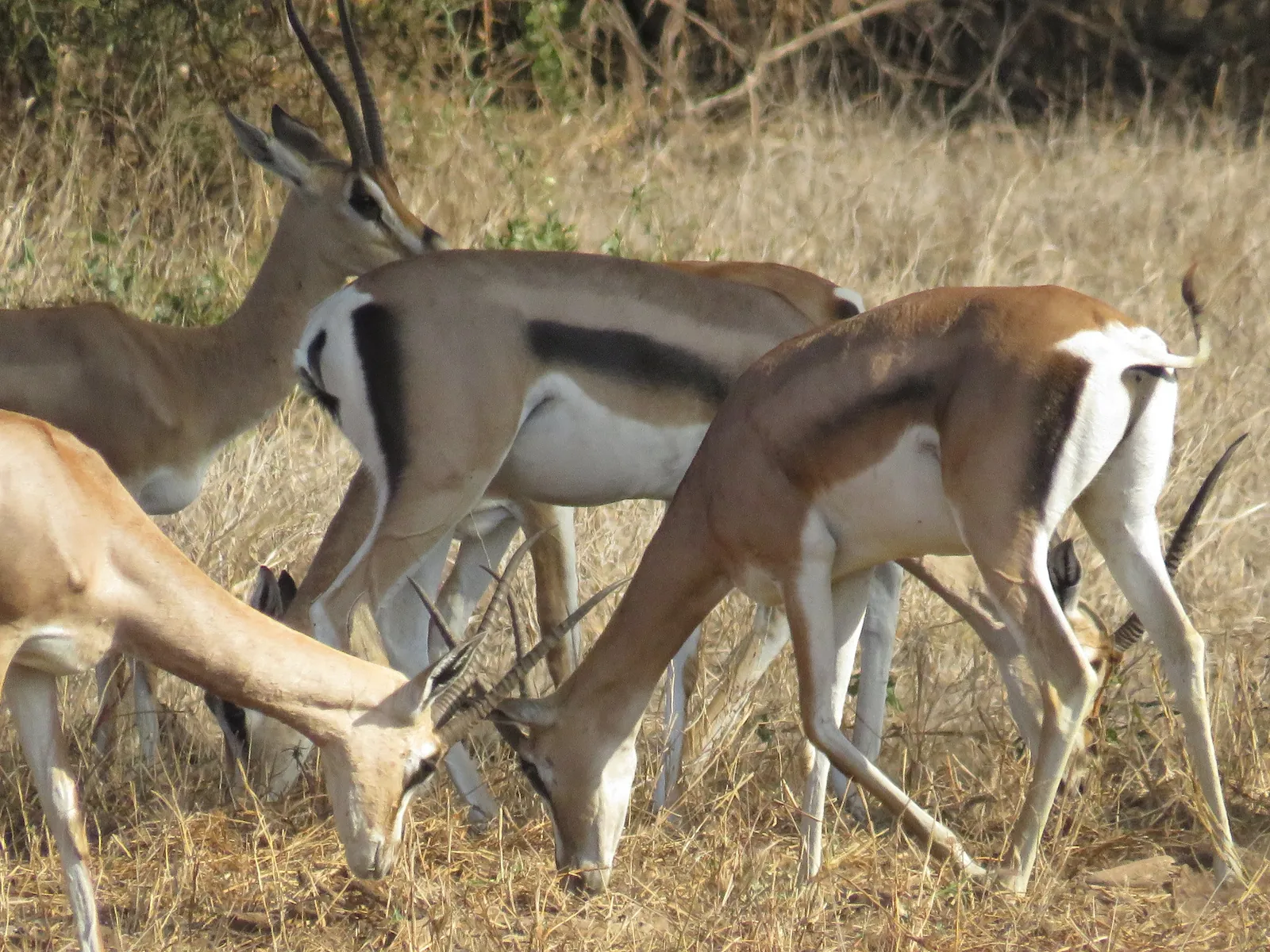
Thomson’s gazelles are small and often in large herds on the open plains, where they “stot”, bouncing on stiff legs to signal alertness. Impala, often mistaken for gazelles, are medium-sized with a black “M” marking on the rump and males with lyre horns; they are antelope but not gazelles. Eland are huge, pale and heavy. Topi have a shiny dark coat and stand on termite mounds. A good guide can help you separate them quickly.
Gazelles and other antelope are prey for lions, leopards, cheetahs, hyenas and wild dogs. Cheetahs, in particular, specialise in Thomson’s gazelles. Speed, agility and large herds are their defences. Watching a chase is a highlight of any Maasai Mara or Serengeti safari.
The open plains of the Maasai Mara and Serengeti are the best places for gazelles. Impala and eland are easy to see at Lake Mburo in Uganda and Akagera in Rwanda. Learn more about the largest herds in our guide to wildebeest facts.
Alongside gazelles and impala, you may see the tiny dik-dik, which is about the size of a hare, graceful waterbuck with a white ring on the rump, sturdy topi that stand sentinel on termite mounds, hartebeest with long faces, and stately oryx with straight horns. In Uganda you might add Uganda kob and bushbuck. Each species occupies a niche, so you will often see several mixed together on one plain.
Early morning and late afternoon provide the best light. Use a long lens, shoot at eye level where possible, and watch for subtle behaviour such as stotting, sparring or mothers nursing. Patience is rewarded with natural, unhurried scenes.
Frequently Asked QuestionsYes. A gazelle is a specific kind of antelope: small, slender and fast.
Antelope is a broad term for many species of horned bovids; gazelles are a smaller group within it.
No. Impala are antelope but not gazelles.
Thomson’s gazelle and Grant’s gazelle are the most common.
No. Antelope horns are permanent, unlike deer antlers.
We schedule drives for the best light and the best chance of action.