The world’s largest gorilla lives in the forests of eastern Congo, but it is not the gorilla travellers trek in Uganda or Rwanda.
Gorillas are divided into two species, the eastern gorilla and the western gorilla, and each has two subspecies. The eastern gorilla includes the mountain gorilla and the eastern lowland gorilla, also called Grauer’s gorilla. They are close relatives with different homes, different numbers and very different travel realities. Many visitors searching for “eastern lowland gorilla” want to know whether they can see one in East Africa, and the honest answer is that most gorilla tourism in Uganda and Rwanda is mountain gorilla trekking.
Quick FactsEastern gorilla (Gorilla beringei), subspecies Grauer’s gorilla (eastern lowland) and the mountain gorilla.
Lowland and mid-altitude forest of eastern Democratic Republic of the Congo.
The largest of all gorillas; males can be heavier than mountain gorilla males.
Classified as critically endangered by the IUCN.
The eastern lowland gorilla, Grauer’s gorilla, lives in the rainforests of eastern Congo, from the lowlands to mid-altitude forest. It has shorter hair than the mountain gorilla, a more robust build and a deeper, blacker coat. Its population has declined sharply in recent decades because of hunting, habitat loss and conflict, and it is listed as critically endangered.
Mountain gorillas are a different subspecies, living at high altitude in the Virunga volcanoes and in Bwindi, with thicker hair adapted to the cold. Their population has grown in recent years thanks to intensive protection and tourism revenue, and they are classified as endangered rather than critically endangered. Mountain gorillas are habituated and offered to visitors in Uganda, Rwanda and the DRC’s Virunga National Park.
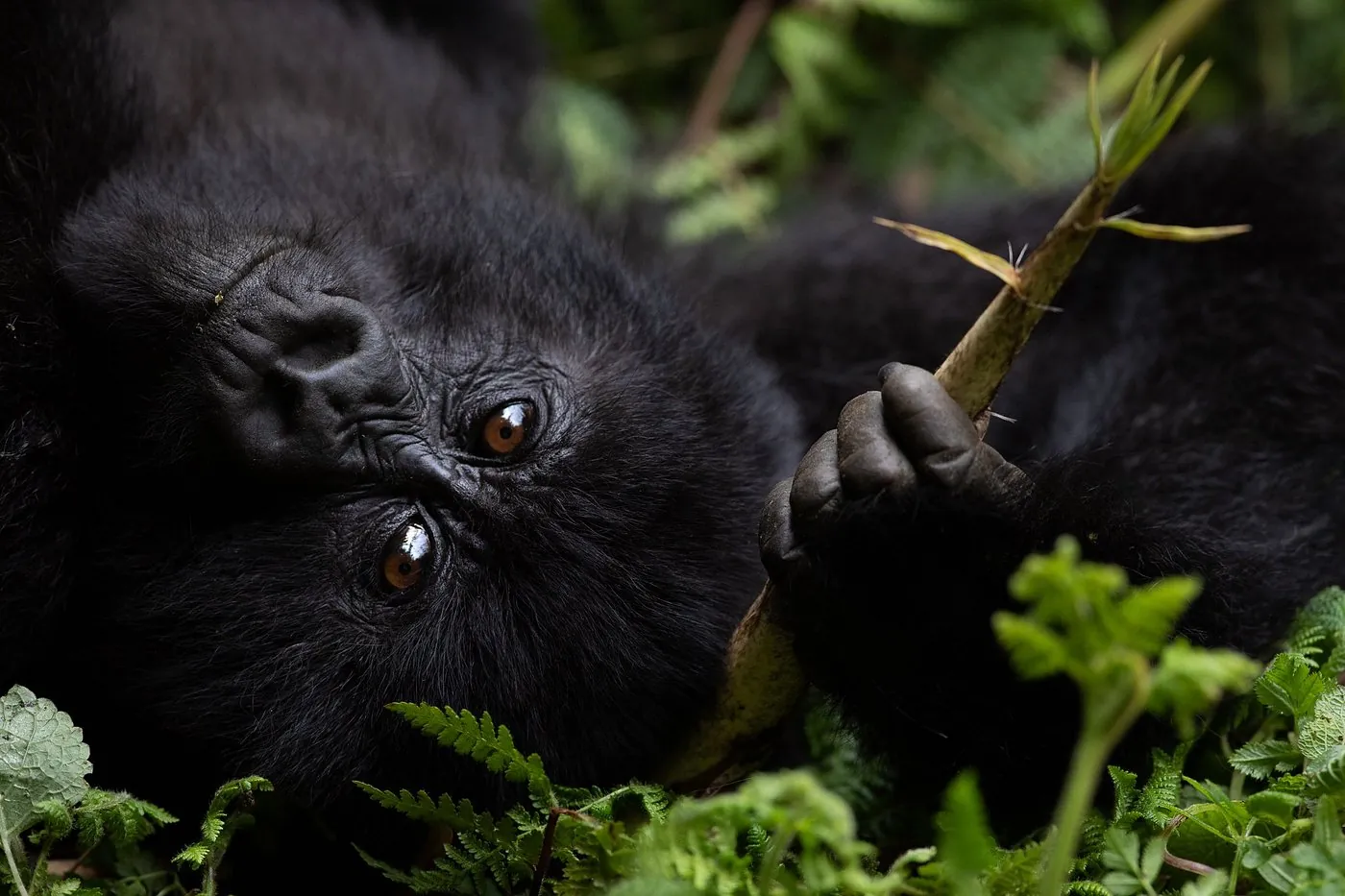
Trekking exists in Kahuzi-Biega National Park in the DRC, but access depends on security conditions and is not part of Ameera’s standard programme. Most travellers choose Uganda or Rwanda for reliable, regulated gorilla trekking. See our primate experiences and the Bwindi guide.
Gorilla trekking permit fees fund park management, community projects and ranger salaries, which is a major reason mountain gorilla numbers have risen. Responsible tourism is one of the most effective conservation tools available. Read about how Ameera supports conservation.
In Uganda, Rwanda and Tanzania you can also track chimpanzees. See our gorilla vs chimpanzee comparison for how the two apes differ.
Grauer’s gorilla has a larger, more robust frame than the mountain gorilla, with shorter hair and a broad face. Groups tend to be larger and more spread out than mountain gorilla families, partly because the lowland forest holds more food. They live at a wide range of altitudes, including bamboo zones, and feed on fruit as well as leaves, depending on the season. Researchers consider them more difficult to habituate because of the dense forest and human pressures.
Choose operators that contribute to conservation programmes, respect permit systems and avoid any product that involves captive gorillas. Support community conservation projects near gorilla parks. The money visitors spend on permits and lodges is directly linked to the survival of these apes.
Frequently Asked QuestionsIt is Grauer’s gorilla, a subspecies of the eastern gorilla that lives in eastern Democratic Republic of the Congo.
Generally yes. Grauer’s gorilla is considered the largest gorilla.
In the Virunga Mountains and in Bwindi Impenetrable National Park.
No. They live in the DRC. Uganda and Rwanda offer mountain gorilla trekking.
Yes, they are classified as critically endangered by the IUCN.
We handle permits, lodges and transfers for Uganda and Rwanda.